

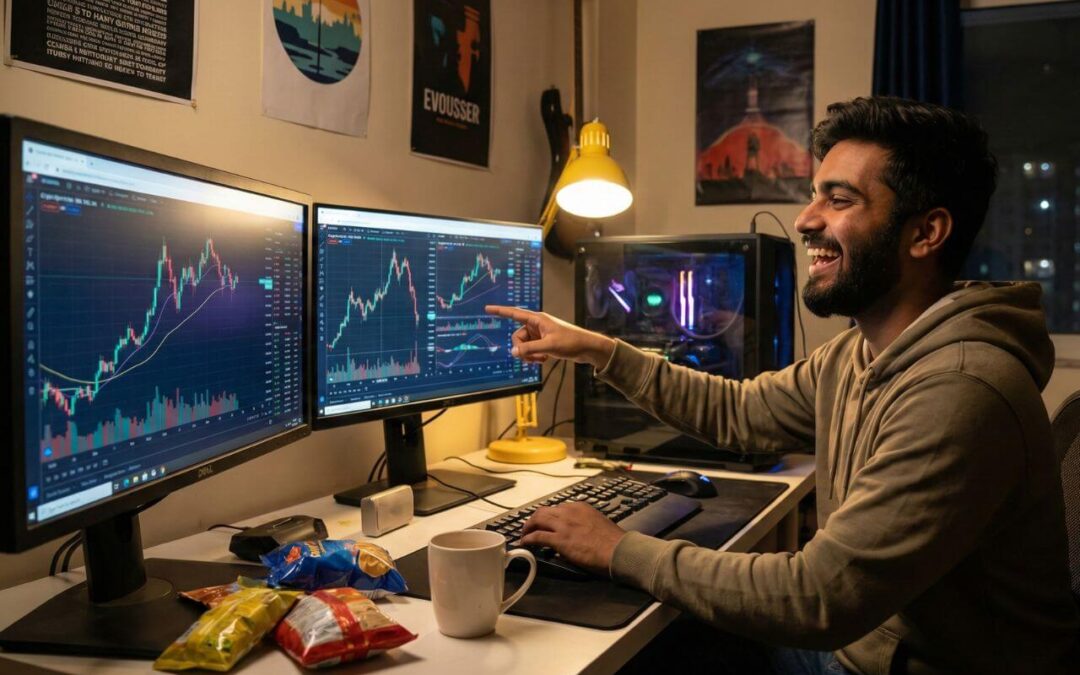
Financial markets are frequently portrayed as rational ecosystems governed by cold, mathematical calculations, algorithmic models, and fundamental asset valuation. Yet behind every green candlestick and every cascading market crash lies the erratic, emotional footprint of human psychology. This reality is magnified exponentially within the cryptocurrency market. Operating twenty-four hours a day, seven days a week, with global accessibility and minimal circuit breakers, digital asset markets function as high-intensity psychological pressure cookers. Two primordial emotional drivers dictate the rhythm of this market more than any technical indicator or economic report: fear and greed. Understanding how these emotional states hijack cognitive processing is vital for anyone attempting to survive and profit in the volatile world of crypto trading.
The Evolutionary Origins of Market Emotions
Human emotional responses were not forged in modern corporate boardrooms or high-frequency trading desks; they evolved over millennia to ensure survival in hostile physical environments. The human brain developed sophisticated chemical signaling mechanisms designed to protect individuals from immediate physical threats and reward them for securing scarce resources.
-
The Fight-or-Flight Response: When early humans encountered predators, adrenaline and cortisol flooded their systems, shutting down long-term strategic thinking and favoring immediate physical action. In crypto trading, a sudden market flash crash triggers this exact biological reflex, causing panicked traders to sell assets at a severe loss just to escape perceived financial destruction.
-
The Resource-Gathering Drive: The pursuit of food and shelter created dopamine pathways that reward risk-taking behavior when resources are abundant. In a roaring bull market, consecutive winning trades release surges of dopamine, convincing traders that their temporary success stems from superior skill rather than random market momentum, fueling reckless leverage deployment.
These archaic survival mechanisms are fundamentally misaligned with the demands of modern financial markets. What kept human ancestors alive on the savannah routinely leads to financial self-sabotage on digital asset exchanges.
The Anatomy of Greed in Bull Markets
Greed in cryptocurrency markets rarely begins as irrational recklessness. It typically starts as sensible participation during a healthy market recovery before slowly morphing into a destructive psychological obsession. As prices climb steadily, positive sentiment feeds upon itself, creating a self-reinforcing feedback loop.
-
Fear of Missing Out: Watching peers accumulate massive paper gains on obscure tokens triggers intense social anxiety and envy, compelling sidelined investors to buy near cycle tops.
-
Overconfidence Bias: A succession of profitable trades convinces participants that they have mastered the market, leading them to abandon risk management rules and invest capital they cannot afford to lose.
-
Leverage Addiction: Seeking to accelerate wealth accumulation, traders turn to high-margin borrowing and derivatives, turning minor market corrections into account-wiping liquidations.
During extreme greed phases, rational asset valuation ceases to matter. Fundamentals are completely ignored, and community hype on social media becomes the primary metric for investment decisions. Traders become completely blind to structural downside risks because their brains are saturated with the anticipation of limitless financial upside.
The Spiral of Fear and Capitulation
When market momentum reverses, the psychological pendulum swings violently from euphoria to terror. Fear acts as a cognitive parasite, clouding judgment and triggering defensive behaviors that exacerbate market downturns.
-
Loss Aversion: Behavioral economics demonstrates that the psychological pain of losing money is twice as intense as the joy of making an equivalent gain. Traders experiencing drawdowns hold onto losing positions far too long, praying for a breakeven bounce that never arrives.
-
Panic Selling and Capitulation: As losses deepen, anxiety crosses into absolute panic. Traders abandon their original investment thesis and sell everything at the absolute market bottom just to halt the emotional torment of watching their net worth shrink.
-
Paralysis and Inaction: Severe fear can also cause analytical paralysis, preventing traders from seizing obvious, high-probability buying opportunities during market panics because the trauma of past losses overrules current market reality.
This cyclical oscillation between manic greed and paralyzing fear transfers wealth away from emotional retail participants and concentrates it in the hands of disciplined institutional players and algorithmic market makers.
Cognitive Biases That Amplify Emotional Trading
Fear and greed do not operate in a vacuum; they exploit pre-existing cognitive shortcuts and biases embedded within human decision-making processes.
-
Confirmation Bias: Stressed traders actively seek out news articles, social media posts, and influencer opinions that validate their existing positions while aggressively dismissing contradictory data.
-
Recency Bias: This bias leads market participants to assume that whatever market trend is occurring right now will continue indefinitely into the future. A prolonged bear market makes traders believe crypto is permanently dead, while a multi-week rally convinces them a crash is impossible.
-
Herd Mentality: Humans are social creatures wired to follow the crowd. When millions of participants rush toward a single narrative, individual critical thinking dissolves, leading to massive speculative bubbles followed by catastrophic unwinds.
Recognizing these psychological traps is the first step toward building mental resilience. Traders who fail to audit their internal biases remain perpetual victims of market sentiment cycles.
Constructing a Psychological Defense System
Defeating fear and greed requires more than simple willpower; it demands a systematic structural framework designed to remove emotional discretion from the execution process.
-
Rigorous Trading Plans: Establishing clear entry prices, profit targets, and stop-loss orders before executing a trade eliminates split-second emotional decision-making during high-volatility events.
-
Strict Capital Allocation: Limiting exposure to a comfortable percentage of overall net worth ensures that a single bad trade or market crash will not threaten personal financial stability or induce panic.
-
Information Diet Management: Disconnecting from real-time price tickers, chaotic Telegram channels, and sensationalist social media feeds drastically reduces the emotional contagion driving impulsive trades.
-
Journaling Emotional States: Maintaining a trading journal that records not only technical setups and financial results but also emotional states helps identify personal psychological triggers and behavioral patterns over time.
By treating trading as a mechanical, rules-based discipline rather than an emotional outlet, investors can drastically reduce the destructive impact of psychological turbulence.
Frequently Asked Questions
What is the Crypto Fear and Greed Index and how is it calculated?
The Crypto Fear and Greed Index is a multi-factor market sentiment analysis tool that aggregates data from volatility, market momentum and volume, social media sentiment, dominance metrics, and Google trends. It produces a numerical score from zero to one hundred, categorizing overall market emotion from extreme fear to extreme greed.
Why do crypto markets appear more emotionally volatile than traditional stock markets?
Cryptocurrency markets feature a higher concentration of retail investors, lack traditional market opening and closing hours, and offer continuous global trading access. Furthermore, the absence of centralized circuit breakers allows emotional cascades to play out rapidly without structural pauses for reflection.
Can institutional investors exploit retail fear and greed cycles?
Institutional trading desks and market makers actively monitor sentiment metrics, liquidation heatmaps, and retail order flow. They frequently leverage retail panic during fear events to accumulate discounted assets or trigger stop-losses before driving prices higher.
How does dopamine addiction manifest in day trading behavior?
Frequent small wins and unpredictable variable rewards on high-frequency trades stimulate dopamine release in the brain, mirroring the neural mechanisms associated with slot machine gambling. This can lead compulsive traders to overtrade long after their analytical edge has been depleted.
Is it possible to completely eliminate emotions while trading digital assets?
Human beings cannot completely eradicate emotions, as they are hardwired biological responses. However, successful traders learn to acknowledge their emotional state without letting it dictate execution decisions, relying instead on automated rules and strict risk management frameworks.
How does a prolonged bear market impact the mental health of retail crypto investors?
Extended bear markets following severe speculative crashes often induce apathy, depression, and financial stress among retail participants who bought near cycle peaks. This psychological exhaustion frequently drives long-term investors to abandon the asset class entirely right before the foundation for the next bull market is established.
